

On Horror Anthologies
A fitting format for a great genre across multiple mediums

I love me a good horror anthology.
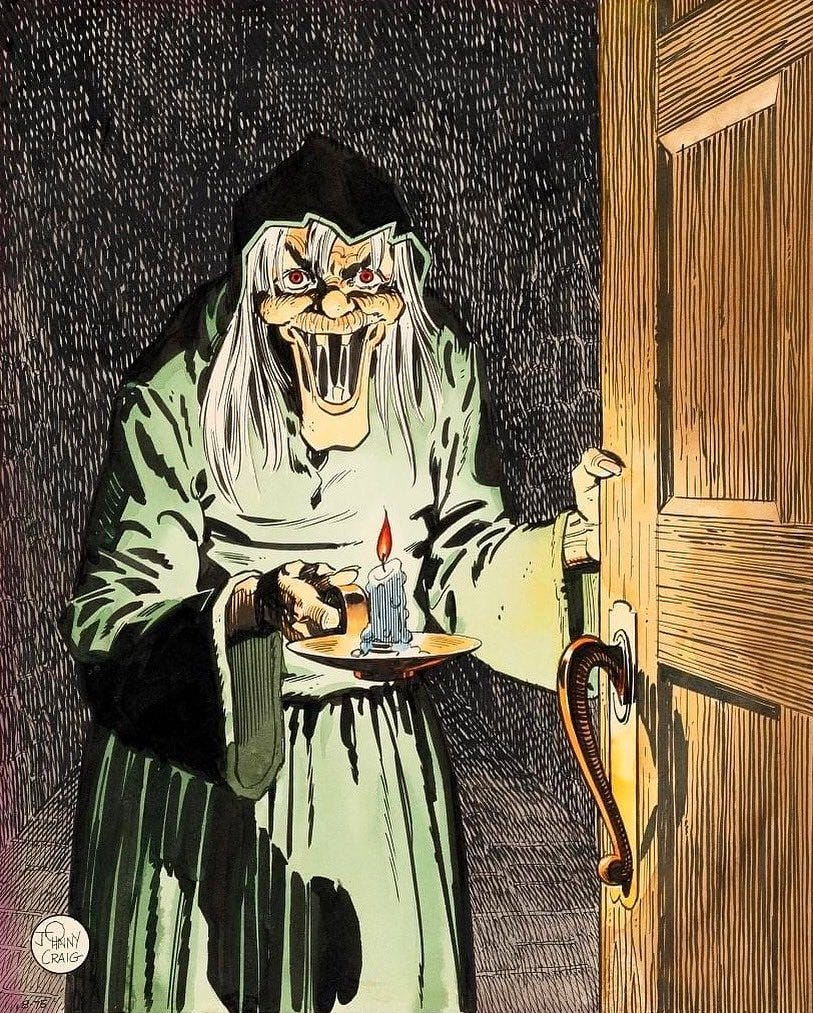
Just something about the horror genre specifically is so well-suited for bite-sized stories—preferably curated by a colorful character like the decaying Crypt-Keeper or the dapper (egad!) Rod Serling.
Granted, anthologies work well with science fiction too, but this particular article just happens to be about the nerdy sci-fi genre’s goth cousin (does this analogy make the fantasy genre the jock…?)—so let’s not get sidetracked.
(Shoutout to Outer Worlds though.)
Before there was the horror anthology, there was the horror host, whose job it was—like the prototypical Vampira, her spiritual successor Elvira, the perennial Svengoolie, and the otherwise normal Joe Bob Briggs, whose gaudy broaches are nonetheless the stuff of nightmares—to introduce late night viewers to campy cult classics and public domain B-movies.
The format found a four-color home inside the newsprint pages of the comic book medium in the '50s, with classic EC Comics titles like Tales from the Crypt, The Vault of Horror, and The Haunt of Fear—funnybooks so infamous that EC editor-in-chief Bill Gaines was forced to testify before congress over charges of indecency. This was around the same time that Fredric Wertham was calling Batman gay in his infamous book Seduction of the Innocent. Wertham has been vilified for this in media ever since (much like his censorship-sympathetic contemporary Joseph McCarthy) but in Wertham’s defense, the current state of the comics industry shows he might’ve been onto something.
DC Comics (home of the aforementioned allegedly-light-in-the-loafers Batman) had House of Mystery and House of Secrets in the '60s and '70s for their horror anthology fare, the hosts of which—Cain and Abel (yes, that Cain and Abel)—were famously brought out of obscurity (from the comics, not from the Bible) by Neil Gaiman in the '80s and '90s for his landmark comic (itself an anthology of sorts) The Sandman.
Current Dynamite Entertainment mainstay Vampirella originally made her bones (pun intended) as a horror hostess for Warren Publishing before breaking out as a main character in her own right. Warren’s other big horror anthology hit was Creepy, which despite its fame I never really read, barring an occasional reprint I might’ve stumbled upon over the years or the 2009 Dark Horse relaunch (when time and money allow I’d love to dive into the archives).
Despite how popular comic books used to be, the anthology format really started to shine in front of a mainstream audience with the advent of television.
The Twilight Zone (1959-1964) isn’t technically a horror anthology, but it certainly has a few genuinely horrifying episodes like “It’s a Good Life” (killer kid story par excellence), “The Howling Man” (supernaturally subtle exercise in impending doom) and a bevy of doll-themed episodes (which are always scary) like “Living Doll,” “The Dummy,” “The After Hours,” and “The New Exhibit.” The 1983 movie, despite having a murderers row of directors directing the individual segments (Landis, Spielberg, Dante, Miller) is mostly remembered for the real-life horror surrounding its tragic production.
Twilight Zone creator Rod Serling would return to host a similar, more specifically horror-focused show called Night Gallery (1970-1973). It has a smart painting-themed premise in which a shaggy-haired seventies Serling plays the part of a museum curator, each work of art acting as a gateway to the episode’s story. There’s a couple of solid Lovecraft adaptations (“Pickman’s Model” and “Cool Air”) and, years after watching it, I’m still haunted by the ending to “The Caterpillar,” (which I won’t spoil here)—an ending that might not have landed if not for actor Laurence Harvey’s pitch perfect performance of pain.
There are two made-for-TV anthology movies worth mentioning, both written or co-written by Twilight Zone alumnus/master of the short story Richard Matheson1 and directed by Dan Curtis, creator of the cult classic supernatural soap opera Dark Shadows (the vampiric main character of which, Barnabas, would’ve made a great horror host):
Trilogy of Terror (1975) - solidified Karen Black’s scream queen status and is mostly remembered for the third segment involving a murderous Zuni fetish doll
Dead of Night (1977) - not to be confused with Dead of Night (1945), the progenitor of the horror anthology format on film; the first segment, “Second Chance,” based on a short story by Body Snatchers creator Jack Finney, feels somewhat Stephen King-esque2 with its admixture of the creepy with cars and Americana, but it’s far more Stand by Me than Christine; in the second segment, “No Such Thing as a Vampire,” Matheson returns to the subject matter of his most famous work, I Am Legend: vampires and their psychosomatic implications; the third segment, “Bobby,” is a classic killer kid story with shades of both Pet Semetary and Don’t Look Now, and was actually filmed twice by Dan Curtis—both here and in the sequel to Trilogy of Terror, the aptly named
Trilogy of Terror II (1996) - also features a less-faithful adaptation of Henry Kuttner’s much-anthologized “The Graveyard Rats” than the one found in Cabinet of Curiosities (which I’ll talk about below) but I will say the animatronic rodents look cool in both
Even to this day, television seems to be the ideal medium for the format. Let’s examine some more of the standouts (in no particular order):
Masters of Horror (2005-2007)3 - probably has the most gratuitous levels of sex and violence of all the shows on this list, which makes sense as it aired on Showtime, HBO’s somehow-even-edgier rival; this anthology provided a cool way to pair famous horror directors (the eponymous “masters”) with famous horror writers, such as Phantasm’s Don Cascarelli with Joe R. Lansdale, Texas Chainsaw Massacre’s Tobe Hopper with Ambrose Bierce, The Shining’s Mick Garris with Clive Barker, and Re-Animator’s Stuart Gordon with Edgar Allan Poe; some filial fun was also to be had (haters will call it nepotism) with An American Werewolf in London’s John Landis directing an episode written by his son Max (“Deer Woman”), Richard Christian Matheson adapting a short story written by his father (“Dance of the Dead”), and John Carpenter’s son Cody providing the musical score for his episodes “Cigarette Burns” and “Pro-Life”; two episodes of Catholic note—“Pro-Life” and “Right to Die,” about abortion and euthanasia respectively—both (unsurprisingly) come out on the wrong side of the issues; Catholics should probably avoid watching “Right to Die” due to a blasphemous sex scene that uses “Ave Maria” as its soundtrack; as for “Pro-Life,” I expected the character of the God-fearing, gun-toting anti-abortion activist to be a cartoonish caricature, but Ron Perlman plays the part with deadly seriousness, which honestly makes it all the more pernicious knowing that the pro-choice creators of the episode genuinely view him as the bad guy4; features a scene of ironic karmic vengeance enacted against the director of the abortion clinic that you have to see to believe
Freddy’s Nightmares (1988-1990) - of all the iconic slasher villains,5 none is better suited to act as a horror host than the wisecracking dream demon Freddy Krueger, making this Nightmare on Elm Street spinoff a no-brainer (some might say in more ways than one); I can’t speak to its quality as my knowledge of the franchise outside the main films is limited to not one but two (!) Freddy-centric rap songs, one by The Fat Boys, the other by Will Smith
Tales from the Crypt (1989-1996) - while it originally aired on HBO in the 1990s, I didn’t see it (for obvious reasons, considering I’m a millennial) until an edited version appeared on the then-Sci-Fi Channel (now called SyFy) in 2003; as a teenager, the show’s campy, almost (dare I say) whimsical tone, with its fanciful Danny Elfman score and comical Crypt-Keeper, felt like a fitting bridge from the more kid-friendly Goosebumps and Are You Afraid of the Dark? (listed below) of my childhood to something more edgy6; standouts include “Only Skin Deep” (not to be confused with a different episode called “Only Sin Deep”) which is one of the few serious, genuinely scary episodes; the fourth wall-breaking “Oil’s Well That Ends Well” in which Crypt-Keeper voice actor John Kassir appears in an onscreen role; and the Goonies-esque “Undertaking Pallor,” which is the episode that got me hooked in the first place; revisiting the series as an adult, there’s an extra layer of enjoyment in spotting all the actor cameos (one episode was even directed by Arnold Schwarzenegger!)
The X-Files (1993-2002) - I suppose this is more of an honorary mention, but I couldn’t resist including it; despite its overarching plot, X-Files was always at its best with the standalone episodes, with Mulder and Scully acting as de facto hosts whose investigations serve as a framing device for all the supernatural shenanigans; sure, like The Twilight Zone, its usually more sci-fi than scary, but some standout scares include “Home” (killer inbred hillbillies) “The Host” (killer mutant parasite) “Chinga” (killer talking doll) and (a personal favorite) “Arcadia” (killer Homeowners Association)
American Horror Story (2011-present) - capitalizing on the critically-acclaimed wave of serialized, season-based television (Sopranos, Breaking Bad, etc), Ryan Murphy co-created this unique anthology in which self-contained stories were told over the course of entire seasons rather than individual episodes; currently on season twelve and counting, I really enjoyed the first three seasons (Murder House, Asylum, and Coven) but checked out of season four (Freak Show) somewhere around the halfway mark; I’ve seen bits and pieces of Hotel and Apocalypse (while skipping the TDS-therapy session that was Cult) and watched the entirety of the semi-found footage Roanoke and the slasher-themed 1984, but my interest in the series has mostly fallen off completely (the elevator pitches for the seasons I’ve yet to watch have done little to motivate me to pick it back up)7
Are You Afraid of the Dark? (1992-1996) - while as a kid I enjoyed both this and that other kid-friendly nineties horror anthology Goosebumps (1995-1998), in my mind the campy R.L. Stine couldn’t hold a candle to the far more serious and scary tales of the Midnight Society; even the intro gave me nightmares, with its haunting theme song juxtaposed with images of creepy dolls, creaky attics, and (the horror!) children’s laughter; episodes that still live rent free in my head all these years later are “The Tale of the Dead Man’s Float” (pool monster), “The Tale of the Ghastly Grinner” (killer clown), and “The Tale of Station 109.1” (Gilbert Gottfried)
Hammer House of Horror (1980) - the venerable Hammer Films (Britain’s answer to the Universal Monster movies) threw their (top)hat into the TV anthology ring in 1980 with this one-season (or should I say series) show; sadly there are no episodes starring Christopher Lee (who became synonymous with Hammer thanks to his recurring role as Count Dracula), though one episode, “The Silent Scream,” stars another frequent Hammer leading man, Peter Cushing,8 as a former Nazi concentration camp doctor looking to continue his human experiments; the show admirably maintains the same saturnine self-seriousness in the face of the outrageous that was a tonal staple of the Hammer films; notable episodes include “The Thirteenth Reunion,” which plays out more like a compelling Agatha Christie mystery than a typical horror show (at least until the blood-curdling twist ending) and “Charlie Boy,” about a killer voodoo doll and the perils of multiculturalism
Monsters (1988-1991) - I’d somehow never heard of this series until researching this article, and as a big fan of the animatronic, pre-CGI practical effects golden age of the 1980s, discovering it was a treat; it has a surprisingly high number of episodes (72), only 24 of which are currently available on streaming; each episode features some sort of animatronic monster, from traditional ones like the troll in “Fool’s Gold” and the reptilian in “Sleeping Dragon,” to more abstract ones like the man-eating mattress in “Pillow Talk” and the giant man-eating bloodworms in “The Mother Instinct”; despite the wacky (in the best way) tone set in the intro (in which a family of hideous monsters sit happily down in front of the TV to watch their favorite show) a lot of the episodes are surprisingly violent and sexually charged: Monsters exists in a mature middle ground between the kid-friendly Goosebumps and the adults-only Tales from the Crypt—a kind of Goosebumps for grownups; there are at least two “killer doll” episodes worth mentioning, one about the animatronic mascot of a Howdy Doody-style kid’s show (shades of Firefly Fun House, M3GAN, and Baby Doll from Batman: The Animated Series) and the other, “Mannekins [sic] of Horror,” which features a creative bit of body horror (based on a short story by Psycho creator Robert Bloch)
Thriller (1960-1962) - not to be confused with the British anthology series of the same name or the Michael Jackson song (though the music video was directed by horror anthologist John Landis); most notable for being hosted by none other than Boris Karloff of Frankenstein and The Mummy fame; features episodes written by pulp legends like Robert E. Howard (“Pigeons from Hell”) and Robert Bloch (“The Weird Tailor”), among others; even though this aired contemporaneously with The Twilight Zone, Thriller’s low-pitched lumbering tone of classic, old school doom and gloom contrasts nicely with The Twilight Zone’s often manic, high-pitched progressive paranoia
Guillermo del Toro’s Cabinet of Curiosities (2022) - produced near the height of woke cultural excess, it hasn’t aged very well, with episodes like “Lot 36” (rightwing bigot gets murdered by demon summoned by Mexican immigrant), and “The Outside” (based on a webcomic written and drawn by a they/them named E.M. Carroll) playing out exactly how you’d expect; in contrast, the Jennifer Kent-directed episode “The Murmuring” (a haunted house story with an avian twist) feels almost Victorian with its manners and morals
There are plenty of great horror anthology movies as well. 3-to-5 segments seems to be the magic number inside the average 90-minute runtime, with some sort of framing plot device usually standing in as the cinematic version of the horror host.
Tales from the Crypt (1972) - dour and moralistic in contrast to the silliness of the HBO series; takes place in a Catholic catacomb, giving the proceedings an added air of legalistic solemnity; instead of the quip-cracking creep of the comics or the equally-irreverent corpse of the show, here The Crypt-Keeper is portrayed with stage play gravitas by Laurence Olivier-contemporary Ralph Richardson, clad in a Franciscan habit and acting less as a host and more of an inquisitor; the Monkey’s Paw-inspired “Wish You Were Here” segment has one of the best twist endings I’ve ever seen
Body Bags (1993) - features several acting cameos by notable horror directors (Carpenter, Hooper, Raimi, Craven, Corman) whose awkward acting is somewhat justified by the intentionally creepy characters they play; the first segment, “The Gas Station,” is a pretty effective piece of suspense that is somewhat tonally at odds with the rest of the film’s campy cadence; the second segment, “Hair,” has all of the darkly comedic absurdity of a Tim and Eric skit, with the usually serious Stacy Keach acting admirably against type to act the fool; the third segment, “Eye,” stars Mark Hamill sporting a mustache and accent that are somehow even more horrifying than all the eyeball-related body horror (indeed, seeing Luke Skywalker’s bare bum ((or his body double’s)) in the sex scene made me want to poke my own eyes out)
Tales from the Darkside: The Movie (1990) - the movie adaptation of the unofficial Creepshow spinoff series of the same name (minus the “The Movie”); the segments are great all around, with stories from Sherlock Holmes creator Arthur Conan Doyle and Stephen King,9 but the wraparound segment steals the show: a modern day Hansel and Gretel-meets-Scheherazade fairy tale about a boy imprisoned by a witch who tells her stories to buy himself time before she inevitably eats him
V/H/S (2012-present) - a film franchise that smartly uses the found footage subgenre as a framing device to explore myriad stories and styles inside the horror anthology bubble; conceptualized by none other than the founder of horror news website Bloody Disgusting (Brad Miska); the inherently low budget/high return business model has ensured that the franchise continues to this day; the segments are at their best (which isn’t often) when they commit to the bit and are filmed (or rather recorded) in the grainy, lo-fi, scanner track-riddled resolution of actual VHS and camcorder footage, as there’s just something inherently more spooky about the physicality of a tape than the digitality of a DVD10
Tales of Halloween (2015) - a tall order of ten tales (as opposed to the three-to-five average) hosted by Creepshow cast member and cartoon Catwoman Adrienne Barbeau; leans more toward comedy than horror—slashstick as opposed to slapstick—but whether or not the jokes land is up to individual (poor) taste; famous horror directors like Mick Garris, Joe Dante, Stuart Gordon, and John Landis make acting cameos (I’m sensing a pattern here)
Trick ‘r Treat (2007) - memorable less for the movie itself and more for its introduction of Funko Pop-friendly horror mascot Sam, a diminutive burlap sack-wearing imp whose evil antics provide the throughline for the various story segments; something similar occurred in All Hallows’ Eve (2013), the anthology where horror icon Art the Clown made his scene-stealing debut that spawned the highly successful Terrifier franchise
When considering the horror anthology format in terms of prose, it usually occurs as a collection of different writers contributing to a book or magazine, often centered around a certain theme. There are also those writers with hyper-specific styles that almost become subgenres unto themselves—like the cosmic mind horror of H.P. Lovecraft or the infernal body horror of Clive Barker—so that collections of their stories feel united around a theme, even if they aren’t, with the author’s general voice and aesthetic acting in the place of a host or a framing device. Stephen King headlined a noteworthy anthology published in 1980 curated by editor Kirby McCauley called Dark Forces, featuring original stories from heavy hitters like Ray Bradbury, Joyce Carol Oates, and Gene Wolfe.
As for video games, and despite how suited the horror genre is to that particular medium, there doesn’t seem to be very many anthologies to speak of outside the recent trend of retro “compilation” releases. I think a kind of “three-in-one” original horror game could be quite successful, especially at a time when so many bloated AAA games require 100+ hour time commitments in an already oversaturated marketplace. The closest example I could find is The Dark Pictures Anthology, which is really more of a series of self-contained games rather than an anthology, strictly speaking, the choose-your-own-adventure style of which evokes Telltale games like The Walking Dead.
I feel like I could go on forever, so I’d like to end this by looking at the Creepshow franchise, arguably the biggest dog in the horror anthology yard. It has appeared in both film and television, and uses the format’s comic book credentials as a smart bit of visual window dressing.
Creepshow (1982) - it’s been a few years since I watched the original, but the Leslie Neilson segment, “Something to Tide You Over,” always stood out to me for being tonally more serious than the rest of the bunch, which is ironic considering Neilson as an actor is best remembered for his comedic roles; that’s not to say it isn’t campy (and the undead ending is decidedly supernatural) but when sandwiched between Steve King’s ham acting in “The Lonesome Death of Jordy Verrill” and the cartoonishly carnivorous creature of “The Crate,” the lover’s revenge plot feels positively pedestrian; “They’re Creeping Up on You!” is insane, but sometimes it gets mixed up in my memory with a similar cockroach-centric episode of The X-Files
Creepshow 2 (1987) - kudos to the fun animated framing device; while SFX legend Tom Savini killed it onscreen as The Creep, the offscreen SFX team (for whom Savini was a consultant) killed it behind-the-scenes, with their impressive showcase of the walking wooden Indian in “Old Chief Wood’nhead,” the muck monster in “The Raft,” and the unkillable knockabout in “The Hitch-hiker”
Creepshow 3 (2006) - I was aware of its awful reputation, but having never seen it myself, I went in ready to give it the benefit of the doubt, thinking maybe (naively) the backlash had more to do with fan resentment at the lack of involvement from King and Romero; my jaw literally dropped at the amateurish quality of the opening animation, so much so that I immediately stopped watching and went to YouTube to watch the trailer (in order to grasp at straws and context) which only added to my disbelief once I saw all the bad fonts and bad acting; at that point I resolved never to waste my time watching the actual movie; it’s one thing for a movie to be bad—or so-bad-it’s-good (which is usually better)—but this is just amateurish at a level that shouldn’t be possible on a 3 million dollar budget and the goodwill of the entire horror community; even the low quality could’ve been mitigated a bit if the producers were able to capture the spirit of the originals, but alas
Creepshow (TV series) (2019-2023) - commits even more to the comic book bit of the original movie; The Creep is weirdly silent, which is somewhat off-putting (and not in the good way), almost like an audio track is missing, with his pithy introductions to each episode relegated to the speech balloons of the animated comic books that act as the framing device (perhaps a voiceover would’ve made him seem too much like Kassir’s Crypt-Keeper?); surprisingly, only two Stephen King stories are adapted in the entire series, “Gray Matter” (acting as the pilot) and “Survivor Type” (part of the animated special, which is really more of a motion comic); maybe, despite King’s connection to the franchise, the bill was too high for Shudder to secure the rights (or maybe they just didn’t want it to turn into The Stephen King Hour); interestingly, King’s son Joe Hill has more “based on” credits here than his father (a bit of trivia made even cooler considering he was a child actor in the original movie!); the best episodes are the ones that act as nostalgic love letters to the horror genre, like “Model Kid,” the plot of which (monster-loving kid takes voodoo doll revenge on abusive father figure) mirrors the plot of the original movie’s frame story; or “Skeletons in the Closet” which showcases props from famous slashers like Freddy (glove), Jason (hockey mask), and Leatherface (chainsaw)—this episode would’ve been far less effective if the writers had to come up with off-brand non-trademarked knock-offs of these characters…presumably showrunner Greg Nicotero used his industry connections to pull some strings and get permission; or “Night of the Living Late Show” in which Justin Long uses VR to insert himself inside old horror movies—this one is impressive on a technical level as it uses real, pre-existing movies for the character to interact with (both Night of the Living Dead ((another nod to Romero)) and a ((non-Hammer)) Lee/Cushing joint called Horror Express)
So there you have it: horror anthologies.
If I were a horror host, I’d end this by delivering a putrid pun…but I’ll leave that sort of thing to the professionals.


Matheson also wrote the screenplay for Roger Corman’s Edgar Allan Poe anthology Tales of Terror (1962)
Which makes sense as King was highly influenced by Finney (as mentioned in his non-fiction book Danse Macabre)
A spiritual successor called Fear Itself (2008) would air a year later on NBC with Garris returning to the helm, but it was cancelled after one season
It should (but unfortunately doesn’t) go without saying that none of the violence in Masters of Horror comes anywhere close to the real-life horror that occurs during an actual abortion
Much like Michael Myers’ notable (and notorious) absence from Halloween III: Season of the Witch, Jason Voorhees was M.I.A from Friday the 13th: The Series, which was less of an episodic anthology and more of a monster-of-the-week serialization
Heck, Crypt was so charming it even had a children’s game show—Secrets of the Cryptkeeper’s Haunted House—and Saturday morning cartoon—Tales from the Cryptkeeper—as spinoffs!
Apparently there’s also a more traditionally episodic spinoff, aptly titled American Horror Stories (2021-present)
There are several non-Hammer British horror anthology films (or portmanteau films, as the Brits call them) produced by Amicus Productions starring or featuring Peter Cushing, one of which was Tales from the Crypt (1972) (listed above) (in which he plays somewhat against type as an eccentric old man rather than his usual stoic man of authority) and at least three of which were written by Robert Bloch: Torture Garden (1967), Asylum (1972) and The House That Dripped Blood (1971) (also starring Christopher Lee)
Other Stephen King anthologies include Cat’s Eye (1985) and Nightmares & Dreamscapes (2006)
Another anthology released the same year, The ABCs of Death (2012), was less successful. This one goes beyond the pale of good, bad, and/or ugly taste, IMHO, (though one could easily say the same about V/H/S) but hey, we all have our lines; most notable for unintentionally revealing the horrors of the public school system
This post speaks to me, top-to-bottom, as I'm a huge horror anthology guy and Creepshow III is butt!
My absolute favorite is Black Sabbath, the atmosphere is so creepy